Welcome to Care Partner Connection, a PWF series where we share stories of some of the unsung heroes in the fight against PD: those who provide critical help to a relative or loved one on their Parkinson’s journey. Often unprepared, these care partners step into their supporting role with uncertainty, courage, and grace. Here, they reveal what lessons they’ve learned from their care partnership experience so that they might empower others navigating a similar path.
Catherine’s Story
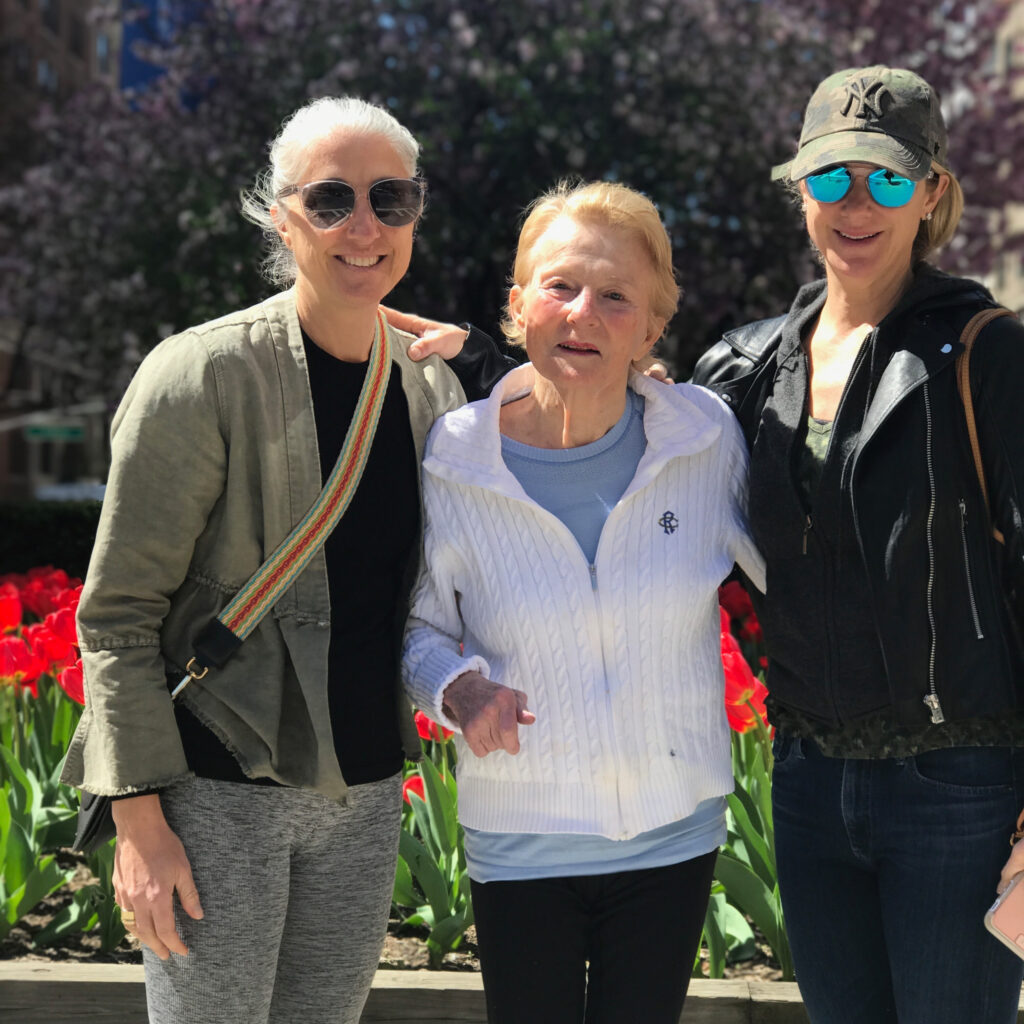
The youngest of two daughters, I grew up outside of Washington, D.C. in McLean, Virginia. Although our mother was our primary caregiver while my father worked, she was a real stalwart of our community, from chairing numerous committees at our school and being an active member of the D.C. Junior League to building a formidable career in real estate. Her clients were CEOs, politicians, journalists, ambassadors, and neighbors—and they all became her friends. Mom was a powerful, beloved figure who modeled hard work and tenacity for her children. Her commanding presence followed her into whatever room, house, or office she entered, and I couldn’t envision a world where that wouldn’t be the case.
My parents were both retired and still living in Virginia when my mom was diagnosed with Parkinson’s, and they were reticent about sharing the news–even with their kids. Mom was in her early 60s, and she discreetly sought treatment and medication from a neurologist at the University of Maryland. For a time, life continued as normal. Our family knew very little about the disease or its implications, and my mom was determined to not let it be at the forefront of her, or our, lives. She hid her tremors well, continued to travel and drive, and when I became a new mom raising babies in New York City, she was an incredibly hands-on grandmother. The only marked difference in my mother’s lifestyle during those years, that I noticed, was her social anxiety. She no longer enjoyed being around people for fear they may notice her Parkinson’s symptoms. Still, she persevered in managing them as if they were insignificant, and we followed her example.
Everything changed when my father died after a brief but brutal battle with colon cancer. My mom was his partner throughout that ordeal, and the strain of his illness, coupled with her profound grief in losing him, put her under tremendous stress. Physiologically, the weight of this grief manifested into back pain, and she ended up having back surgery from which she never fully recovered. Almost overnight, my mom became immobile and needed full-time care. My husband and I moved her from Virginia to an apartment near us in New York so we could better manage the situation.
We were fortunate to be able to provide Mom with live-in care who could assist her medically, so our role as a family could be reserved for emotional support. When she first moved to New York, my mom and I often met for lunch, and my children would come visit her after school. But as her Parkinson’s progressed, she became increasingly reclusive. I tried to keep her active by suggesting we tour the Met or meet up with some of her old friends, but she was so self-conscious of her walking that she lost interest in socializing. It didn’t occur to me to research support groups or Parkinson’s communities that may have benefitted her; I just wanted my mom to be who she had always been: the unflappable go-getter, the charismatic party guest, the endearing mother and grandparent. In retrospect, I see now that I wasn’t meeting her where she was. I didn’t know how to. There was very little available to me in the way of care partner support. My mom’s isolation and depression was heartbreaking. She lived with Parkinson’s for over 20 years, finally succumbing to the disease shortly before the holidays in 2023.
What would I do differently, knowing what I know now? I would have tried to give Mom more agency in the decision making, as much as her situation allowed . There was no question she needed proximity to family once my dad passed away, but I wish I had taken the time to help her understand why, so transitioning her life from Virginia to New York was welcome, not jarring. I also wouldn’t impose my ideas on how to improve her life, however well-intended they were. Pushing her to do things outside of her comfort zone, such as site-seeing or social engagements, overwhelmed and frustrated both of us. I wish I had focused on smaller, doable things, like practicing patience and taking it one day at a time, to help build the connection that my mother needed. Most of all, I wish I had known how to seek support from the Parkinson’s community, for both of us. It was too much to manage alone.
That’s why I am proud to be part of the Parkinson’s Wellness Foundation. In building the space and community that could have bettered my mom’s life, I honor her extraordinary legacy. We need to change the way we care for people with neurological disorders—not just in New York City, but everywhere. My fervent hope is that PWF can have the broadest reach possible, empowering the lives of everyone living with Parkinson’s, and change the dialogue around how we engage with people who have PD. Parkinson’s shouldn’t define you. Thanks to PWF, it doesn’t have to.