“It turned out to be more satisfying and compelling than anything else I have done.” When you consider David Leventhal’s long and distinguished artistic career, which includes a 14-year run with the famed Mark Morris Dance Group (MMDG); appearing on stage at Lincoln Center, the Met and the Kennedy Center (among others); authoring chapters of some of the leading studies on the intersection of dance and Parkinson’s disease; and a shelf replete with awards or prizes that recognize both his incredible talent and his commitment to humanitarian service, it might be difficult to guess which experience from his long list of successes renders him the most proud. But for David, the answer is obvious and unyielding: “Dance for PD.”
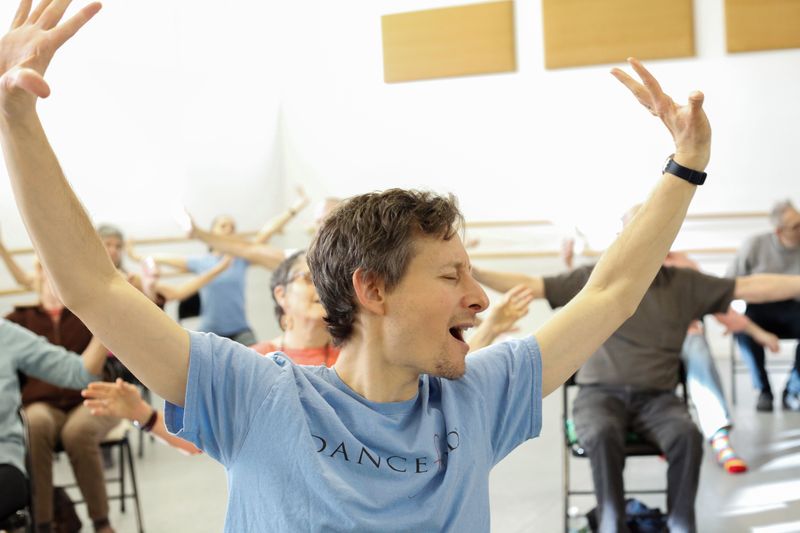
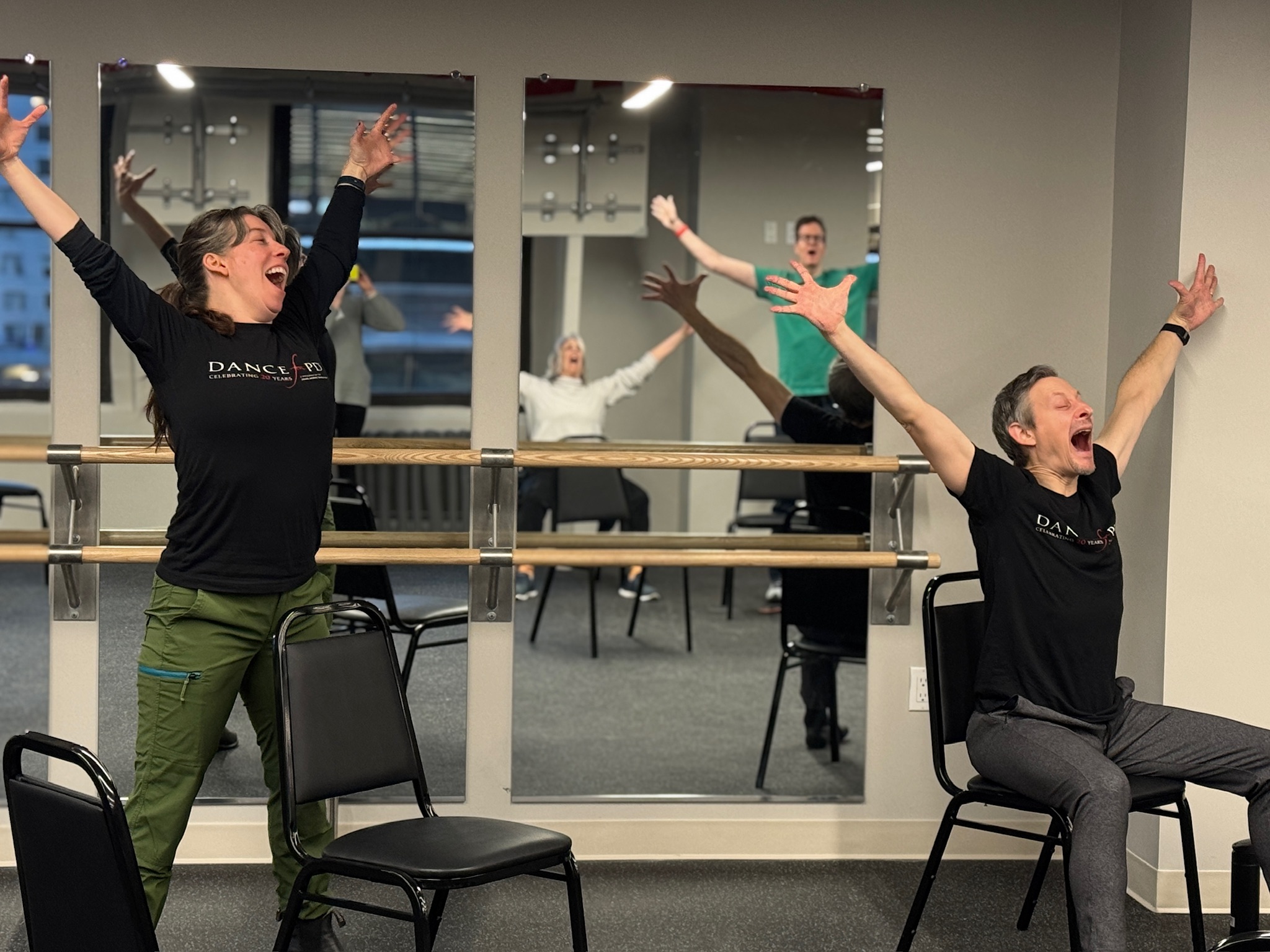
Dance for PD, a program of MMDG that David helped start 25 years ago with a class of six people in Brooklyn, is now an international sensation. Available in New York City, online, and in 30 countries around the world, this renowned program offers research-backed dance classes for people with Parkinson’s disease. As the Parkinson’s Wellness Foundation got off the ground, David and his Dance for PD colleagues were instrumental in helping co-founders Derek and Bonnie Bandeen source the appropriate equipment for The Bandeen Center, from the multipurpose floor to the ergonomic chairs that best support people whose mobility and balance might be impacted by PD symptoms. Now, Dance for PD is a proud partner of The Bandeen Center, and it seemed only fitting that this groundbreaking facility in Midtown Manhattan, dedicated entirely to bettering the Parkinson’s community with bespoke science-based fitness, wellness, and support programs, invited David and the Dance For PD participants to be The Center’s inaugural group fitness class. “It was an honor!” he enthused about the hour-long session that incorporated salsa, pop choreography, breathwork, and a playful staging of a West Side Story-inspired rumble between the Jets and the Sharks.
In this latest “Ask an Expert” feature, David discusses his passion for dance and how it empowers people living with Parkinson’s.
As a professional dancer, you’ve been in the game a long time. How did you discover your passion for dance?
I’m not from a family of performing artists, but I am from a family that valued the arts. My mother was a music teacher before I was born, and both my parents are still active in community choruses. Actually, my first ‘aesthetic movement’ experience was figure skating. I found dance the way a lot of people do–I tried a class on the recommendation of a friend, loved the music, and something lit up. Suddenly, my body felt like it had a language I didn’t know I’d been missing. I trained at Boston Ballet really intensely until age 13, when I quit cold turkey. But I came back to it, more recreationally, in high school and then found modern dance my first week of college. It was love at first sight (again!). The nurturing came primarily from really passionate, knowledgeable, and caring teachers, whose collective inspiration is the reason I’m a dance educator today.
What was your first big break as a dancer? When did you feel like you had “made it,” or that you could make dancing your career?
I moved to New York after college, like so many young hopeful artists. I freelanced, did office temp work to pay bills, and tried to go to as many auditions as possible: modern companies, ballet companies, Broadway. About a year after I moved, I got a call from the office of the Mark Morris Dance Group (MMDG), letting me know about an audition the next day. But a previously scheduled rehearsal meant that I was two hours late to the audition. I returned on day two with no nerves because I knew I had absolutely no chance of getting the job. Except I did get the job, as an understudy for one of Morris’ most admired works, L’Allegro. It was on the second tour that someone got injured and I had to go in, so I guess you could say that was my break. But there were so many incredible opportunities along the way, and I never actually felt like I made it. I chose liberal arts over conservatory training, which left me with a nagging sense of imposter syndrome. Being a professional dancer has such a high level of unpredictability, so you’re just grateful for each day you get to perform.
You’re a founding teacher of Dance for PD. How did that opportunity come about for you, and what compelled you to take it?
In 2001, Olie Westheimer, founder of the Brooklyn Parkinson Group, approached MMDG Executive Director Nancy Umanoff with a bold idea: a real dance class for people with Parkinson’s, taught by professional dancers, with live music. The Mark Morris Dance Center had just opened, and we wanted it to be truly accessible to the community. A few months later, I taught the first class with a musician for just six people. My colleague John Heginbotham joined me for the second class, and we then co-taught together for about ten years along with our dear, late colleague Misty Owens.
I didn’t know anything about Parkinson’s when I started, aside from a few insights Olie shared. But I was deeply interested in teaching beyond the traditional dance world. The thought of working with people navigating movement challenges was intriguing, and Olie’s vision was crystal clear: this wasn’t about “symptoms first.” It was about art, music, craft, and community. That focus changed everything.
What has most surprised you about the evolution of Dance for PD?
I never could have predicted the scale, the depth, or global interest in dance as a modality for managing Parkinson’s. We began with one class a month in Brooklyn. Now there’s a global network of programs inspired by the Brooklyn model, and an entire field that has taken movement-and-arts-based wellness seriously. But the biggest surprise is the consistency of the human experience. Everywhere this program takes root, a real community forms. People come for the movement, but they stay for the artistry, the belonging, and that feeling of, “Oh!—I’m still me.” Along with the evidenced motor skills, cognitive stimulation, and mental health support dance fosters, it’s also a powerful medium for people to remember their humanity, their capacity for expression and joy, and their identity as everything they were (and still are) before Parkinson’s. We didn’t set out to create a global movement. We set out to offer a joyful, accessible dance experience that respects people, challenges them artistically, and welcomes them fully, with dignity. 25 years in, and that’s still the north star.
How does dancing benefit people living with Parkinson’s?
Dance is uniquely powerful because it’s not just exercise—it’s strategy, artistry, and social connection wrapped into one hour. Dancers spend their lives practicing balance, rhythm, coordination, sequencing, and expressive clarity, and we translate those active ingredients—what I call the “dancer’s toolkit”—into an accessible experience for people with PD. All of this started as an experiment, but now more than 50 peer-reviewed studies underpin the efficacy and benefits of what we do in Dance for PD. In class, we see participants become more fluid, more intentional, more confident—often in a single session. And because dance is enjoyable, people keep coming back (that matters more than we sometimes admit for a condition that can cause apathy and fatigue). Day-to-day, what I witness most clearly is this: People don’t just “move more;” they reclaim a sense of agency, creativity, and connection. They focus on the possibilities of what they can still do. The movement element of class is important, but it’s also a vehicle for self-efficacy, improved mood, and—I’m just going to say it—fun and joy. The importance of fun should not be underestimated.
What’s your advice for someone who just learned of a Parkinson’s diagnosis, whether it’s their own diagnosis or someone they love?
To someone newly diagnosed, I would tell them to build a “wellness portfolio” early: movement/exercise, plus medication, plus compassionate medical care that treats you like a partner, plus community. Parkinson’s is often described as a movement disorder, but it’s also a quality-of-life challenge, so you need to create an ecosystem for yourself that addresses all of the various physical, cognitive, emotional and social issues you may encounter. Next, choose activities you’ll actually stick with and that offer rigor, flexibility (you can do them on good days and difficult days), and a sense of meaning and purpose. The arts, and especially dance, are particularly compelling in this regard. You don’t have to have any artistic talent to reap enormous health benefits.
If your relative or friend received a PD diagnosis, and you find yourself in the position of care partner, I encourage you to remember that you are not “support staff;” you’re part of the ecosystem. You need to find community too. If you can participate alongside your loved one, whether in a dance class or another group activity, you’re not just helping them; you’re strengthening the relationship, reducing isolation, and giving both of you a shared language that isn’t merely medical. You also need to take time for yourself so that you can recharge and have the energy to do what you need to do.
What excited you about partnering with the Parkinson’s Wellness Foundation?
We’re excited because like us, the Parkinson’s Wellness Foundation has a clear focus and deep dedication to people impacted by Parkinson’s, and it shares our belief that high-quality movement experiences don’t just improve function; they empower individuals and create community. We love partners who care about the “how:” quality, consistency, warmth, just as much as the “what.” When a partner understands that wellness includes joy, belonging, and creativity—not as extras, but as essentials—that’s when real momentum happens. And the Parkinson’s Wellness Foundation encompasses all of those values.

Anything else you want to share?
Mark Morris says, “Dance isn’t for everyone, but it is for anybody.” I’ve seen that become true in thousands of different people, in countless different rooms. And it never stops being kind of miraculous.
Thank you, David! Starting this spring, Dance For PD classes will be offered at The Bandeen Center. If interested in learning more about participating, please contact us about our fitness schedule and membership. If you’re looking for a Dance For PD class beyond Midtown Manhattan, check out their website to find a local or online option.